Quoted from: http://www.physorg.com/news162753069.html May 28th
VIB researchers linked to K.U.Leuven and Harvard University show that stretches of DNA previously believed to be useless 'junk' DNA play a vital role in the evolution of our genome. They found that unstable pieces of junk DNA help tuning gene activity and enable organisms to quickly adapt to changes in their environments. The results will be published in the reputed scientific Journal Science.
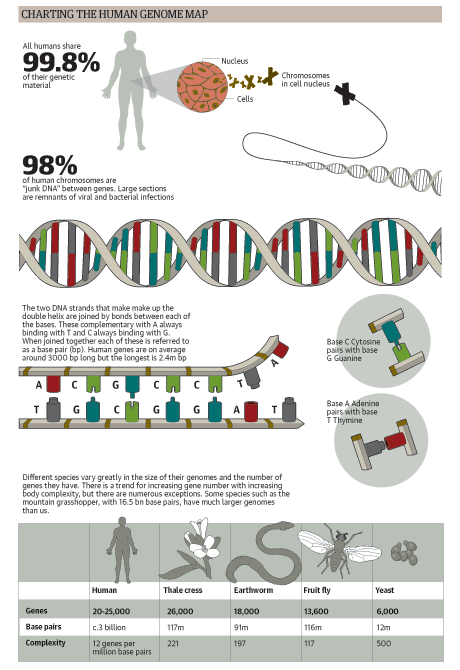
Junk DNA
'Most people do not realize that all our genes only comprise about 3% of the total human genome. The rest is basically one large black box', says Kevin Verstrepen, heading the research team. 'Why do we have this DNA, what is it doing?'.
Scientists used to believe that most of the DNA outside of genes, the so-called non-coding DNA, is useless trash that has sneaked into our genome and refuses to leave. One commonly known example of such 'junk DNA' are the so-called tandem repeats, short stretches of DNA that are repeated head-to-tail. 'At first sight, it may seem unlikely that this stutter-DNA has any biological function', says Marcelo Vinces, one of the lead authors on the paper. 'On the other hand, it seems hard to believe that nature would foster such a wasteful system'.
Unstable repeats
The international team of scientists found that stretches of tandem repeats influence the activity of neighboring genes. The repeats determine how tightly the local DNA is wrapped around specific proteins called 'nucleosomes', and this packaging structure dictates to what extent genes can be activated. Interestingly, tandem repeats are very unstable - the number of repeats changes frequently when the DNA is copied. These changes affect the local DNA packaging, which in turn alters gene activity. In this way, unstable junk DNA allows fast shifts in gene activity, which may allow organisms to tune the activity of genes to match changing environments -a vital principle for survival in the endless evolutionary race.
Evolution in test tubes
To further test their theory, the researchers conducted a complex experiment aimed at mimicking biological evolution, using yeast cells as Darwinian guinea pigs. Their results show that when a repeat is present near a gene, it is possible to select yeast mutants that show vastly increased activity of this gene. However, when the repeat region was removed, this fast evolution was impossible. 'If this was the real world' the researchers say 'only cells with the repeats would be able to swiftly adapt to changes, thereby beating their repeat-less counterparts in the game of evolution. Their junk DNA saved their lives'.
Source: VIB (the Flanders Institute for Biotechnology)


